
"Why are you tapping on my neck?"
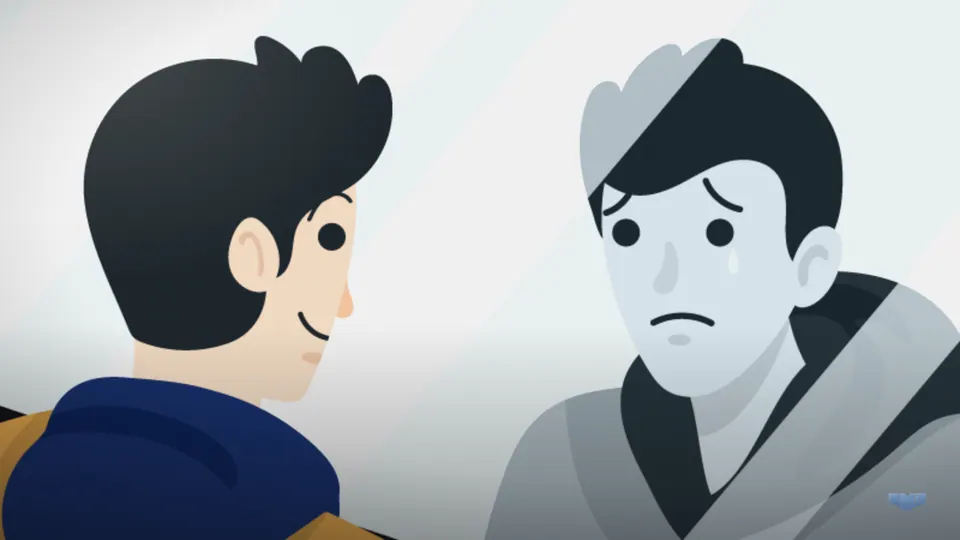
Picture the moment. The client turns round mid-session, half curious and half suspicious, and for a second you hear yourself reaching for words like "energy" and "release" that you wouldn't want your old anatomy lecturer to hear. It's an uncomfortable second, and it doesn't need to happen. There's a clear answer, and it's more interesting than the vague one.
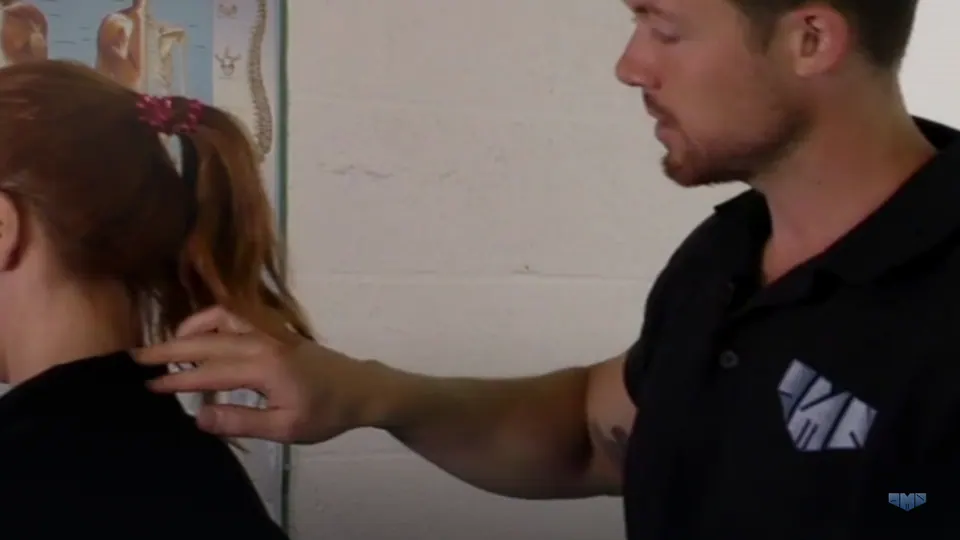
Here's what the client is asking about. In lesson 4 of our free Calibrate Screening Tools mini class, I test the lat, the broad muscle down the side of the back. Then I spend about ten seconds lightly tapping with my fingertips around C6 and C7, the vertebrae at the base of the neck, and along the spine of the scapula, the bony ridge across the shoulder blade on the same side. Then I run the same test again, and it's "a really nice lock." The arm holds.
There are two ways to teach something like this. One presents tapping as a little bit of magic. The other treats it as an input you can test, explains the science that's solid, and says clearly where the theory begins. At AMN we're firmly in the second camp, so let's take it piece by piece.
What does a gas lighter have in common with your shoulder blade?
Click a push-button gas lighter and a small hammer inside strikes a crystal. Squeezed suddenly, the crystal produces a burst of voltage, and that's your spark. No battery required. This is the piezoelectric effect: some materials produce a small electrical charge when force changes their shape.
Bone is one of them. In 1957 two Japanese researchers, Eiichi Fukada and Iwao Yasuda, measured the effect in dried bone and put it down to collagen, the fibrous protein that forms much of bone's framework. It's the same collagen we talk about constantly in AMN, because it runs through tendon, fascia and every connective tissue you put your hands on.
Bear with me, because living bone is wet, and that changes the story. Later work found that bone still behaves piezoelectrically when it contains moisture. But wet bone also does something else. When you load it, fluid is squeezed through its tiny channels, and because that fluid carries charged particles, its movement creates a small voltage of its own. This is called a streaming potential. In living bone, researchers now see fluid flow and streaming potentials as a big part of how bone senses load, and exactly how much the collagen's piezoelectricity adds is still being debated.
If you've done our Cervical Spine workshop, that term will sound familiar. There we compare two kinds of touch through a muscle test: a sustained compression into the tissue, and a swipe through it in a particular direction, which the workshop describes as "setting up a streaming potential." The bone research gives that idea real physiology to stand on. It doesn't prove that a particular swipe or tap produces the change we propose, and we'll come back to that.
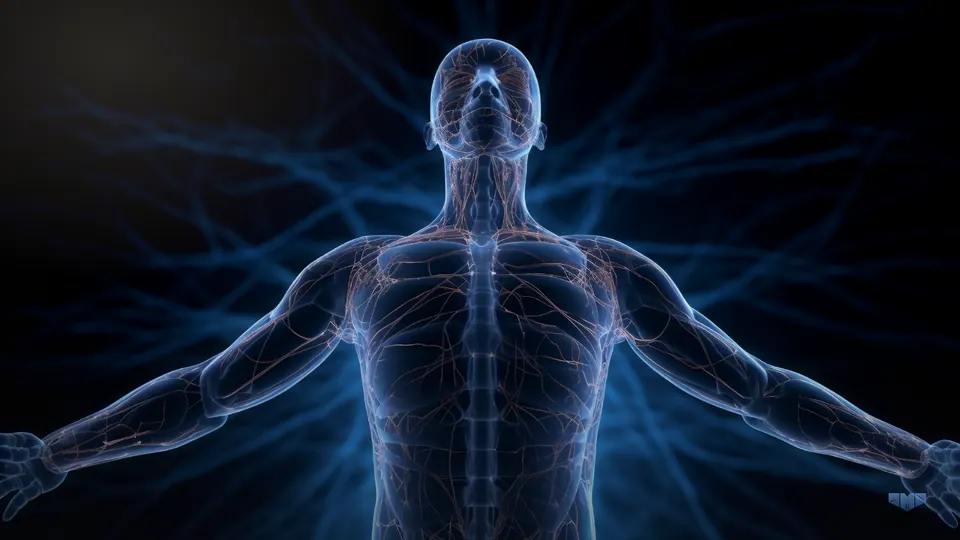
In basic terms, then: bone and collagen respond to pressure electrically. That part is measured physics.
Your tap may be reaching the inner ear too
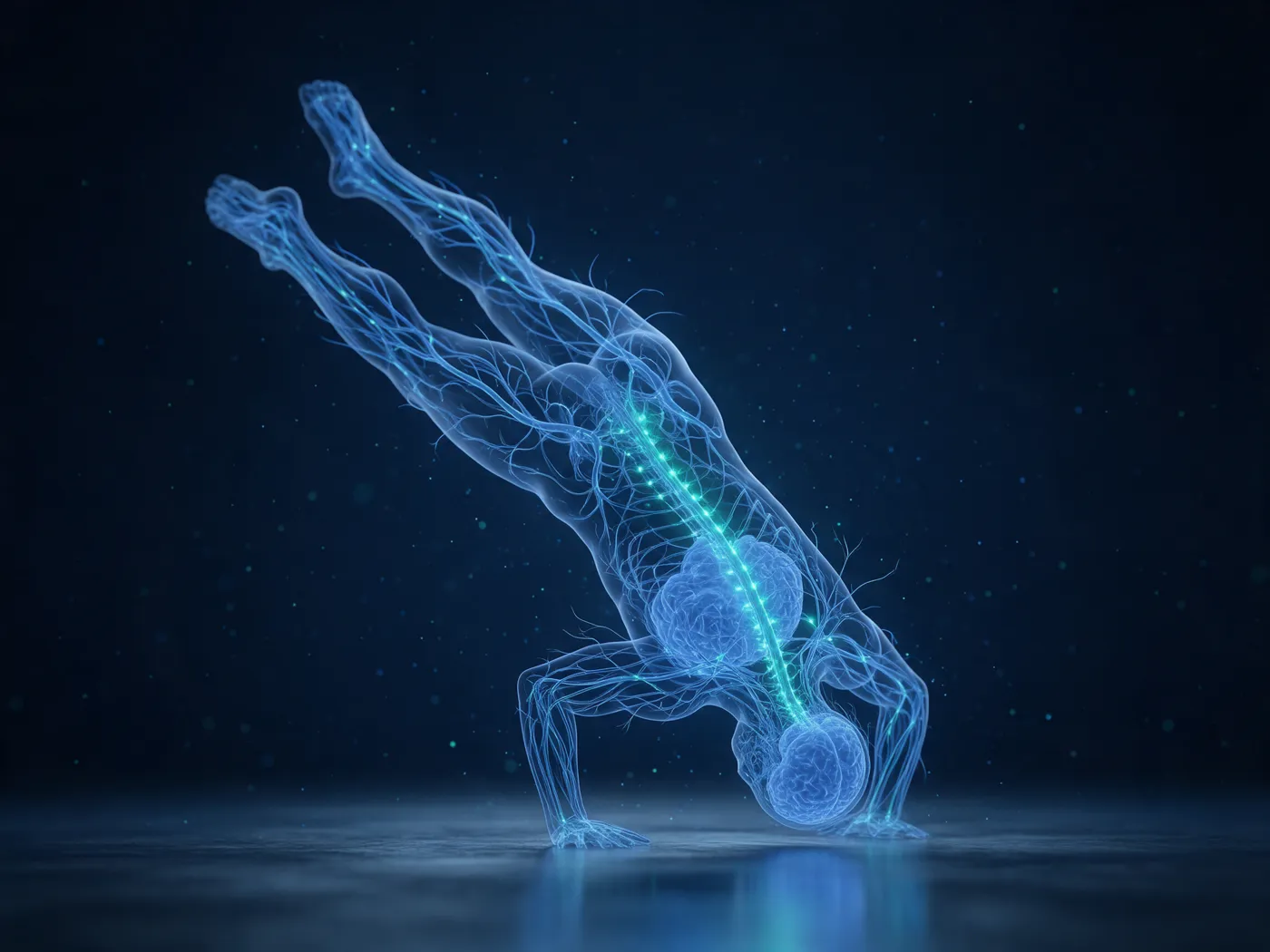
There's another possible route to consider when you tap near the head and neck, and it's a lovely bit of neurology. Inside each inner ear sit the otolith organs, tiny sensors that detect gravity and movement in a straight line. They're part of the vestibular system, your balance system, which has its own direct pathways down the spinal cord and helps set the background tone of the postural muscles that hold you up.
A vibration travels through bone remarkably well. Vestibular clinics use this to test the otoliths: a tap on the forehead with a reflex hammer, or a small vibrator behind the ear, activates them and produces a measurable reflex in the neck muscles. Researchers have been recording these responses since the 1990s.
So a mechanical input near the head can reach the balance system and, through it, the muscles. As far as I know, nobody has measured whether gentle fingertip taps on the lower neck do the same, but it's a well-documented route, and it belongs in any honest answer to "why does tapping change the test?"
How we use tapping at AMN
The Corrective Exercise course puts the method in one line: touch as an assessment, the manual muscle test as feedback, and bone tapping as a stimulus. You make a contact, you watch how the muscle test responds, you apply an input, and you test again. Tapping is never the whole session. It's one input, and the retest lets you compare the response afterwards.
Level 1 uses a short tapping sequence on three bony sites: the cranium, the spines of the scapulae and the sacrum, the bone at the back of the pelvis. In one demonstration it takes about ten to fifteen seconds. The course also uses heel drops, where the client rises up and drops onto the heels, as another way of putting a mechanical input through the body, and it describes that as both a piezoelectric and a vestibular stimulus.
For a single muscle, the free class works locally. To choose your sites, it says, think about the spinal levels involved, where the nerves go, and the bones the muscle attaches to. The lat is supplied by the thoracodorsal nerve, which carries fibres from C6 to C8, so C6 and C7 and the shoulder blade on the same side make sense as targets. The Corrective Exercise course adds a useful caveat: the piezo effect is a generic response, and you can get it by tapping any bone in the body. Choosing sites linked to the muscle is part of our rationale. The physics alone wouldn't pick them for you.
Where the science stops
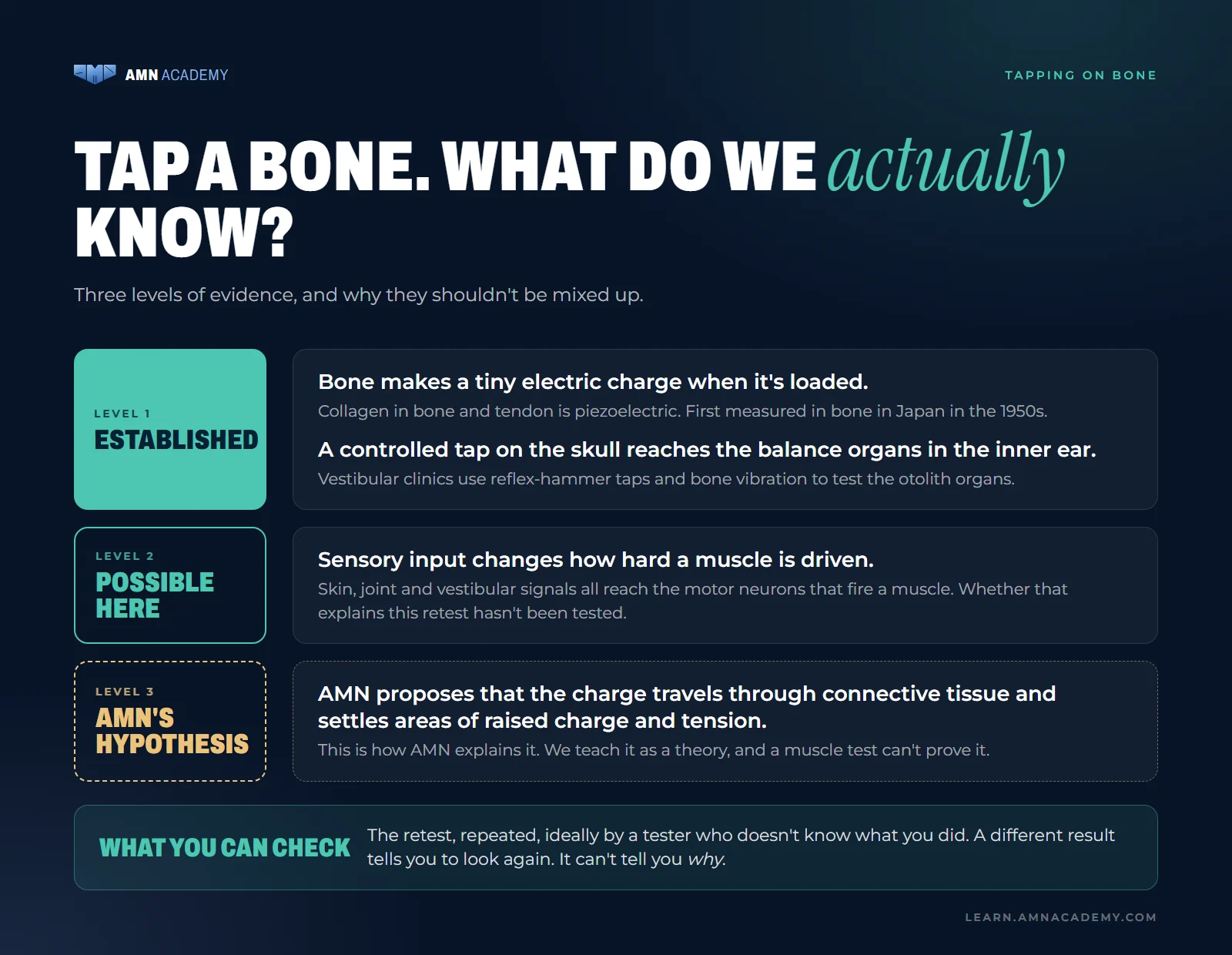
Our model goes like this: touch meets areas of raised electrical charge and tension, and tapping supplies a small electrical input that lets those areas settle. That's the AMN explanation, and it's a theory. The muscle test can't measure tissue charge, so a change in the arm can't confirm it.
We say this in the courses too. Writing about touch testing, Level 1 puts it in black and white: "We accept that the explanation of the mechanism is theoretical." The same honesty applies to tapping. Level 1 also states that the AMN Calibrate approach "cannot diagnose or treat specific medical or neurological conditions."
I'd rather you knew exactly where that line sits. It makes it far easier to answer a sceptical client honestly, without overselling and without going vague.
What the retest can and can't tell you
I open lesson 1 of the free class with a sentence worth putting on every treatment room wall:
To know if you're changing anything, you do need an assessment process.
The good news is that a manual muscle test can be a reliable assessment. In a 2018 review of nine studies, Richard Bohannon found substantial or almost perfect agreement, between testers and on repeat testing, for most of the muscle actions studied. The review's conclusion is the important part, though: reliable results may be obtained, but they can't be assumed, and there's still too little research across different conditions, muscles and test procedures. It also wasn't a review of AMN's own testing, and it says nothing about our proposed mechanism.
In your own room, reliability comes down to consistency. Keep everything the same: the client's position, your stabilisation, your words, the direction and build-up of your pressure. A slightly different pull gives you a slightly different answer. Expectation plays a part too, on both sides of the table. If you can, ask a colleague who doesn't know whether you tapped to run the retest.
And when the lat locks after tapping, here's the honest reading. On this day, with this client, this input was followed by a different result on this test. That's genuinely useful. A retest can show you a different result. It can't tell you why.
Try this with your next client
- Take a full medical and injury history first, and use the assessment protocols that fit the person in front of you. Tell the client what you're about to do and why.
- Set up the lat test from lesson 1: arm by the side, turned in, elbow as straight as is comfortable, taken back a little. Stabilise the shoulder, place your other hand on the inside of the wrist, and ask the client to pull the arm straight back against you. Note whether it locks or gives.
- Tap lightly with your fingertips for about ten seconds around C6 and C7 and along the spine of the scapula on the same side, working out towards its end. In the video I tap both areas in the same ten seconds.
- Retest with the same position, stabilisation, words and pressure. Write down what happened, including "no clear change". If nothing changes, don't tap harder or longer to force it. Note it and try another input.
- If a colleague is around, have them run the retest without knowing whether you tapped. It takes your own expectation out of the picture, and you can check whether the difference repeats.
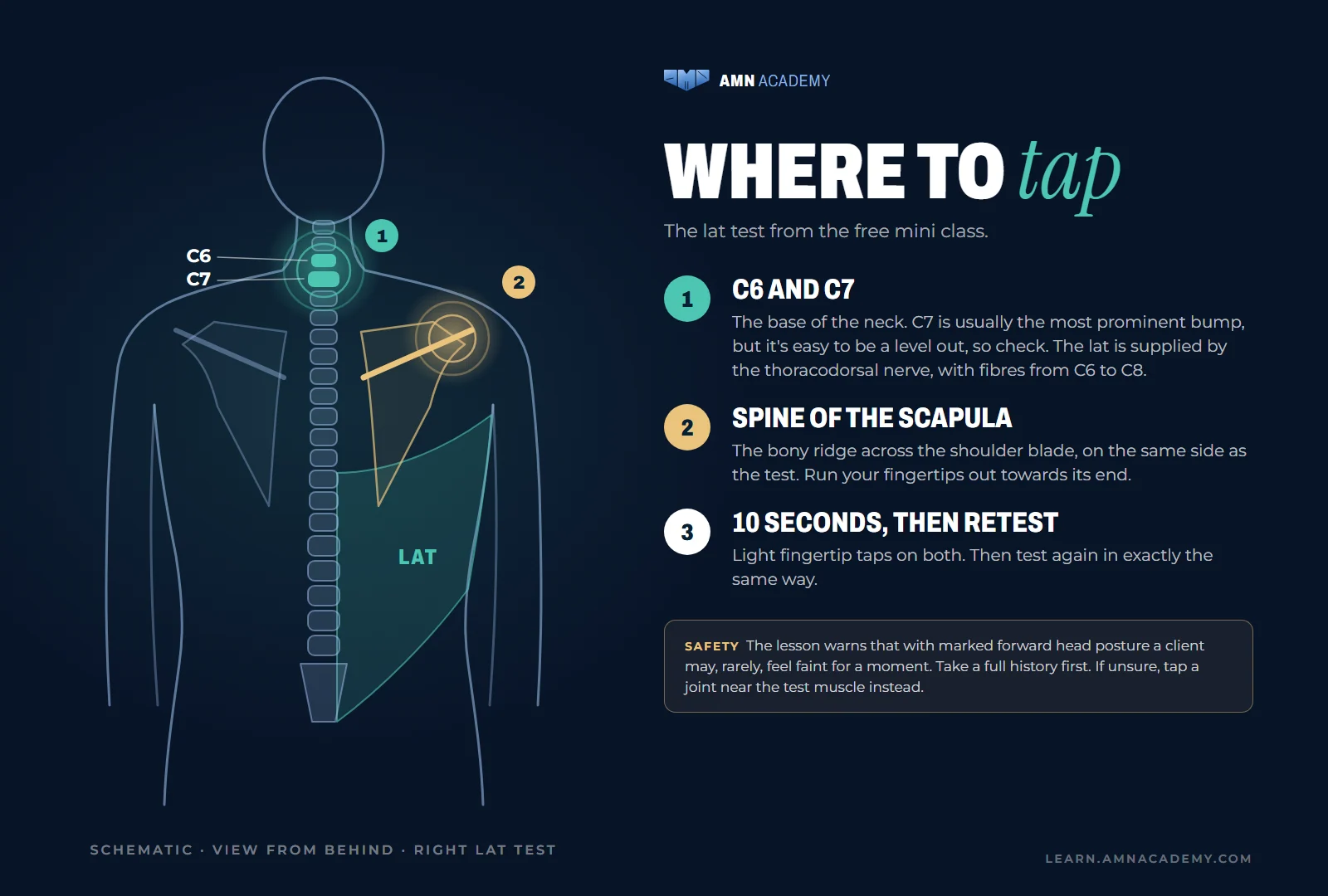
Safety note. The lesson warns that clients with particularly poor spinal posture, such as a marked forward head, may in rare cases feel faint for a moment when the vertebrae are tapped. It explains this as a sudden shift towards the rest-and-digest side of the nervous system, which is part of the same theory. Take the history first, and if you're unsure, tap another area linked to the test muscle instead, such as a nearby joint. Stop if the client feels unwell.
What to tell your client
Back to that moment when the client turns round. Here's something you can say, in your own words, in about forty seconds:
"Bone works a bit like the crystal in a gas lighter. Press or tap it and it makes a tiny bit of electricity, and tapping also gives your nervous system some information. We don't know exactly which of those explains a change in this test. I'm going to test how your arm holds, tap two spots for about ten seconds, then repeat exactly the same test. If it changes, we'll check it again to see whether it holds. It doesn't diagnose anything or show that I've treated anything. It's information, and we'll use it."
It's honest, and it's a lot more interesting than "it releases energy".
See it for yourself
If the bioelectric side of the body has you hooked, our article on bioelectricity and your clients goes further. And to watch the pre-test, the tapping and the retest in one take, go to lesson 4 of the free Calibrate Screening Tools mini class. It's seven short lessons, it costs nothing, and you can try the first test on your next client.
References
- Fukada E, Yasuda I. On the piezoelectric effect of bone. Journal of the Physical Society of Japan, 1957; 12(10): 1158–1162.
- Reinish GB, Nowick AS. Piezoelectric properties of bone as functions of moisture content. Nature, 1975; 253: 626–627.
- Ahn AC, Grodzinsky AJ. Relevance of collagen piezoelectricity to "Wolff's Law": a critical review. Medical Engineering & Physics, 2009; 31(7): 733–741.
- Halmagyi GM, Yavor RA, Colebatch JG. Tapping the head activates the vestibular system: a new use for the clinical reflex hammer. Neurology, 1995.
- Welgampola MS, Rosengren SM, Halmagyi GM, Colebatch JG. Vestibular activation by bone conducted sound. Journal of Neurology, Neurosurgery & Psychiatry, 2003; 74(6): 771–778.
- Bohannon RW. Reliability of manual muscle testing: a systematic review. Isokinetics and Exercise Science, 2018; 26(4): 245–252.
- AMN course material: the free Calibrate Screening Tools mini class, Level 1 Certification, the Corrective Exercise Specialist Certification and the Cervical Spine AMN Calibration Workshop.